


With less than a month to The Gambia’s December 5, 2026 presidential election, the Independent Electoral Commission (IEC) has been busy with major statutory and technical duties involving aspirants and other major stakeholders.
On November 2, 2026, the IEC addressed a press conference where Chairperson Joseph Colley briefed the media on key milestones and preparations for the presidential election.
Below are major points he shared during the briefing at Election House, Kanifing:
- Court proceedings resulted in the removal of 165 names from the 2026 provisional voters’ register out of 1,694 objections filed.
- The Master Register as at November 2 stood at 1,146,474 registered voters.
- There would be 1,773 polling stations across the country.
- A total of 27 aspiring candidates collected nomination forms according to the IEC’s nomination schedule.
- Collection of nomination papers starts from 3rd to 14th November 2026.
- A 15-day window for the free replacement of lost, damaged, or mutilated voters’ cards at all ten IEC offices nationwide (1st to 15th November, 2026).
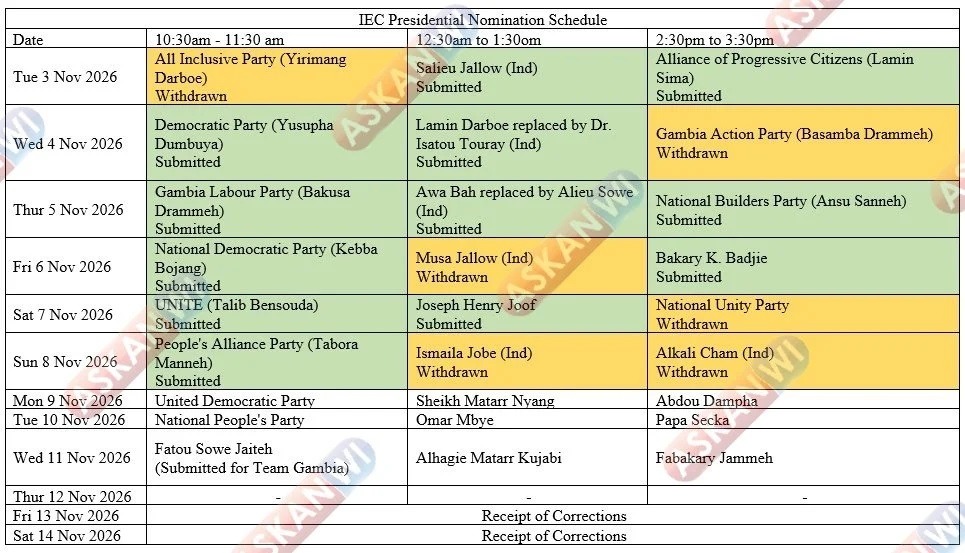
Despite a total of 27 aspirants – parties and independent candidates – filing to contest, the IEC confirmed that after receiving nomination papers for 18 aspirants, six (three parties and independents apiece) had withdrawn their nominations (read here, here, here)
Local fact-checking platform Askanwi have mapped out the withdrawals in the image below:
The journey from nomination to candidature
When a person seeking to be elected President submits required documents and evidence to the IEC, they are deemed to have submitted their nomination.
Under Section 38 of the Elections Act, 2025, all presidential aspirants must be formally nominated and must meet the qualifications for the office under the 1997 Constitution, the current Elections Act and other relevant laws.
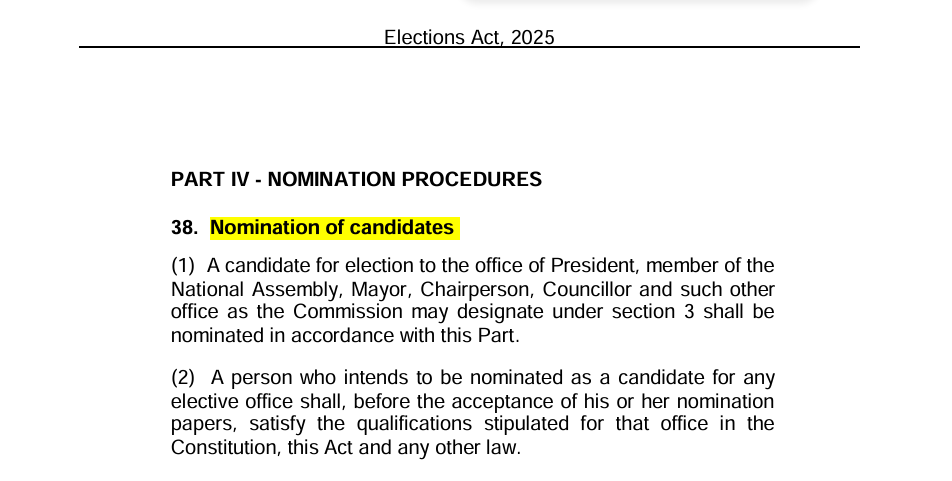
Requirements for presidential nominees. According to the Electoral laws:
- The person must be nominated by at least 5,000 registered voters, with at least 2,000 voters drawn from each Administrative Area.
- The person must provide the telephone contact details of all voters nominating them and subscribe to the nomination declaration.
They must also submit:
- a sworn declaration of assets; and
- a certificate from the revenue authority confirming that all taxes due have been paid.
Nomination papers by law are free of charge. Section 41 (5) of the Elections Act reads: “All nomination papers shall be obtained free of charge from the appropriate Returning Officer at any time before the close of nominations.”
Filing fees
Section 42 of the Act 2025 mandates a presidential candidate to deposit D1 million (dalasi) when the nomination paper is delivered. “The payment of a deposit under sub-section (1) shall – (a) be paid to an account designated by the Commission; (b) and not be valid without proof of the payment.”
In the case of the presidential election, the IEC’s designated official vets the nomination papers and accompanying documents. In the event that all legal requirements are met, the nomination is accepted, and the person is formally deemed nominated.
The papers, on the other hand, can be rejected on stated grounds.
The IEC is also allowed to accept nomination papers and to point out modifications that candidates must make within a timeframe; failure to do so, their nominations can be rejected. In the instant case, the IEC has asked some candidates to collect signatures to achieve the threshold required by law.
Section 46 (3) reads: “The rejection of a nomination paper shall be without prejudice to the delivering of a fresh nomination paper, which is delivered before the close of nominations.”
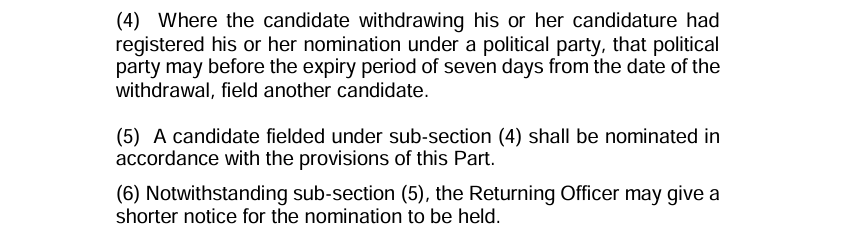
What does the law say about withdrawals?
Section 50 of the law deals with “Withdrawal of candidature,” outlining the procedure involved: It reads: (1) A candidate may withdraw from his or her candidature by notice in writing signed by him or her, and delivered by himself or herself or one of the persons nominating him or her to the Returning Officer not later than eleven days before the date of election.”
Clause (3) stated that the Returning Officer shall –
- (a) hand over to the candidate or his or her representative the appropriate Acceptance of Withdrawal form for endorsement; and
- (b) keep the original of the form and deliver the duplicate to the candidate or his or her representative and, if the candidate was registered under a political party, give notice to the party of the candidate’s withdrawal.
What happens after the close of nominations?
Section 51 caters for “Publication of particulars of candidates”
A Returning Officer shall, as soon as practicable after the close of nominations, immediately after the withdrawal period before the day of election, or, if the election is to be held over a period of days, before the first day of that period, publish the –
- (a) names and details of all registered candidates;
- (b) names and details of all persons nominating candidates; and
- (c)representative symbol approved for each candidate.
Conclusion
Mid-November is a key period in the pre-election process, with nominations ending on the 14th and replacement of voters’ cards ending on the 15th. The publication of approved aspirants will follow. The campaign period per the IEC calendar is scheduled to run from November 16 to December 3, followed by a cooling-off day on December 4.