

Researched by Lara Zofio
Introduction
Clean cooking, “the use of modern, sustainable fuels and technologies for cooking”, is becoming a priority in the agendas of several governments and institutions around the world, especially in Africa.
“Based on the latest tracking, more than 70% of Africans without access (to clean cooking) live in countries that have strengthened their clean cooking policy frameworks since 2024, with 40 new policies now in place” the International Energy Agency (IEA) states.
The transition to clean energy sources for cooking could save millions of lives. In their 2025 report, the UN states that currently, around a quarter of the global population (+2.1 billion people) don’t have access to clean cooking and still rely on biomass fuels, mainly firewood and charcoal.
This leads to harmful household air pollution (HAP), which is a major cause of premature deaths globally. Only in 2023, the latest year with data available, 2.8 million deaths worldwide were “attributable to exposure to HAP”, according to State of Global Air.
RelatedNews




But the impact of this problem is uneven around the world. Nearly half (49%) of the deficit in access to clean cooking is in sub-Saharan Africa. In a recent fact check conducted by FactSpace following a claim by First Lady Dr. Fatima Maada Bio, we found that access to clean cooking in Sierra Leone is limited to around 1.5% of the population.
In this article, we will explore the situation in the region.
Sub-Saharan Africa – A region woefully lagging
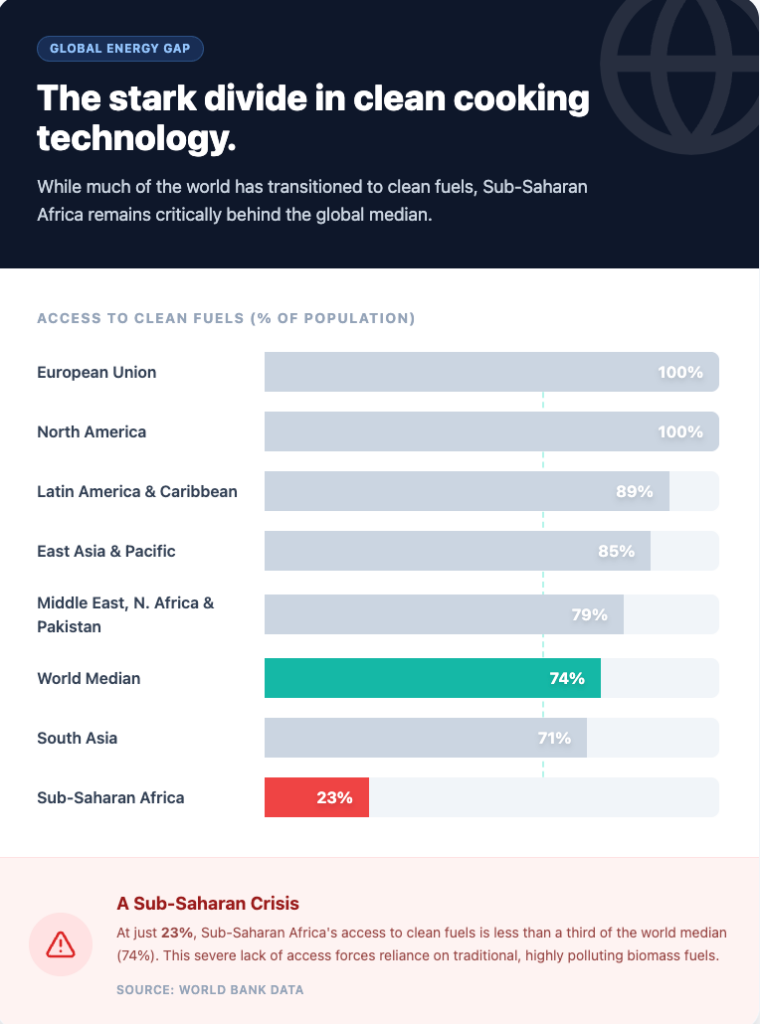
According to World Bank data, global access stood at around 74% in 2023, although this average masks significant regional disparities. Europe and North America report universal access, at 100%. Other regions lag behind, including Latin America and the Caribbean (89%) and Asia (85%). The lowest levels are found in Sub-Saharan Africa, where access averages only 23%, placing the region far below the global average.
This regional gap is also reflected in assessments by the African Energy Commission (AFREC), a specialised agency of the African Union, which identifies Sub-Saharan Africa as the region most affected by a lack of access to clean cooking worldwide. In their 2024 report, AFREC noted that, if current trends continue, “by 2030, four out of every five people in sub-Saharan Africa will still endure the health and socioeconomic burdens associated with cooking poverty.”
Clean cooking data: Focus on Anglophone West Africa
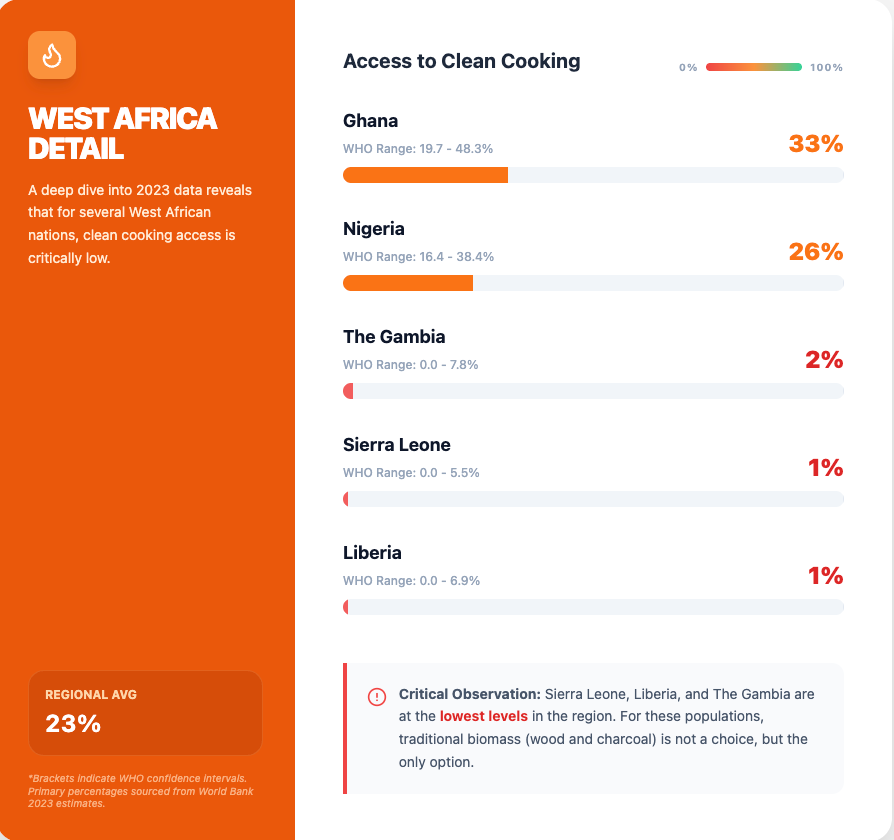
FactSpace analyzed data from the WHO and the World Bank, indicating that The Gambia, Liberia, and Sierra Leone are among the countries with the lowest levels of access to clean cooking in Sub-Saharan Africa.
Within English-speaking West Africa, the data shows a clear divide in access. Ghana leads the sub-region, followed by Nigeria, while the remaining countries fall significantly behind. The gap is particularly pronounced, with Ghana at around 33% access, compared to roughly 1% in Liberia and Sierra Leone, underscoring deep inequalities in access to clean cooking technologies across the sub-region.
What the UN says about clean cooking
First, it’s important to understand why transitioning to clean cooking is paramount. Globally, it can reduce emissions, strengthen food security, reduce pressure on forests and agricultural lands, have health benefits, address the gender dimension of this problem, and allow governments to create jobs and increase productivity, as the UN points out.
“Strengthening clean cooking targets and actions as part of NDCs and national policy processes will be essential to achieving the Sustainable Development Goals (SDGs) and Paris Agreement targets” the UN adds.
The Clean Cooking Alliance, a public-private partnership promoted by the UN on this issue, explains that clean cooking can contribute to several Sustainable Development Goals (SDGs), especially SDG 7, that has a specific indicator that calls for “access to affordable, reliable, sustainable and modern energy for all”. More generally, it can also contribute directly to achieving 10 of the 17 SDGs.
In Africa the benefits can be decisive, as it has the lowest access rates globally, and according to the UN, “Africa is the only region in the world in which the absolute number of people without access continues to rise. In 2023, the population lacking access reached 960 million people – an increase of 14 million from 2022.”
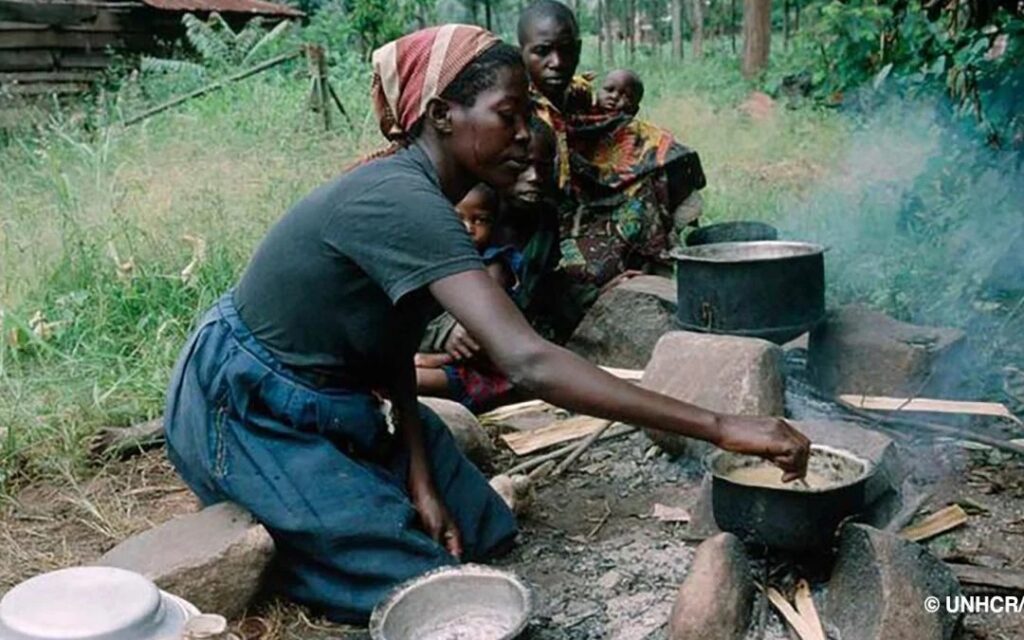
The lack of access to clean cooking methods on the continent is linked to health problems, deaths, deforestation, and, according to the IEA, the emissions resulting from such access are equivalent to “a quarter of current energy-related CO2 emissions in Africa.”
Some barriers to clean cooking access in the sub-Saharan region
- Lack Of Awareness: One of the most common arguments suggests that the main barrier is the lack of knowledge about the harms of traditional biomass cooking and the availability of alternatives among households in many developing countries. Source: African Energy Commission and Clean Cooking Alliance.
- Economic Constraints: Affordability and credit restrictions remain a major obstacle; nearly two-thirds of sub-Saharan Africans would have to spend more than 10% of their income to adopt clean cooking solutions. Furthermore, inflation and rising prices have a significant impact. Source: African Energy Commission and IEA.
- Market Barriers: Inefficient distribution and supply chain problems due to a lack of institutional coordination and inadequate regulatory frameworks. High taxes and misaligned tariff codes hinder industry growth and create an unfavorable business environment. Source: African Energy Commission and IEA.
- Population Growth: In some countries the population growth has outpaced the annual increase in access to clean cooking. Sources: African Energy Commission, UN, and International Energy Agency.
- Gap Between Rural And Urban Areas: Rural communities often lack access to essential services, infrastructure, and economic opportunities compared to their urban counterparts. This gap has widened over the past two decades. Source: African Energy Commission.
- Infrastructure: Low rates of access to electricity and unreliable service, along with problems in port, primary storage, and distribution infrastructure across the continent, with rural areas being the most affected. Source: IEA
- Ineffective Policies: Market policies and the inefficiency of programs that aim to reach low-income households, but often have difficulty reaching them effectively. Source: IEA
Governmental and institutional efforts
To curb a deadly trend on the continent, African and international governments and institutions are taking action.
In May of 2024, the Summit on Clean Cooking in Africa hosted by IEA in Paris concluded with a commitment of US$2.2 billion in financing and investments from government and private sector sources to expand clean cooking solutions across the continent.
That same year, at COP 29 (Azerbaijan), clean cooking was included as a priority in the African Energy Efficiency Strategy and the African Energy Efficiency Alliance,
At the Africa Energy Summit in Tanzania in January 2025, 12 African countries presented National Energy Compacts that include clean cooking targets and priorities for 2030. Clean cooking is also a priority in events such as the Africa Climate Summit.
Furthermore, investment in clean cooking infrastructure in Africa has also been increasing, led by the private sector.
Thanks to these efforts, nowadays most people in sub-Saharan Africa live in countries that have accelerated their clean cooking efforts since 2024. This pattern mirrors the broader situation highlighted earlier: more than 70% of Africans without access currently live in countries that have strengthened their clean cooking policy frameworks since 2024, according to IEA’s latest tracking.
In the last five years, approximately 13 million people have gained access to clean cookstoves each year in sub-Saharan Africa, 20% more than the average of the last decade, driven by progress in West and East Africa.
“By matching best historical performance, Africa could reach universal clean cooking access around 2040” explains IEA, but it “will require efforts across governments, industry, civil society, and the international community”.
Conclusion
Despite recent political momentum and growing investment commitments, access to clean cooking in sub-Saharan Africa remains critically low, with uneven progress both between and within countries.
While some governments have begun to accelerate reforms and expand infrastructure, the scale of the challenge continues to outpace current progress, leaving hundreds of millions of people still dependent on traditional biomass.
Without sustained funding, more effective implementation, and targeted support for the most affected households, the region risks falling short of global clean cooking targets and continuing to bear the greatest burden of cooking poverty in the world.