

Claim: Only 1.5% of Sierra Leone population use clean cooking energy
Source: First Lady Fatima Maada Bio
Verdict: True
Researched by Lara Zofio
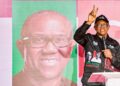
The First Lady of Sierra Leone, Dr. Fatima Maada Bio, was appointed Regional Clean Cooking Champion for West Africa on 28 April, during the official launching of the 2026 ECOWAS Liquid Petroleum Gas (LPG) Programme.
RelatedNews
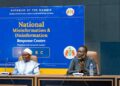
The launch, which took place in Freetown, Sierra Leone; also served as a High-Level Policy Dialogue on Clean Cooking, Gender Equality, and Child Protection.
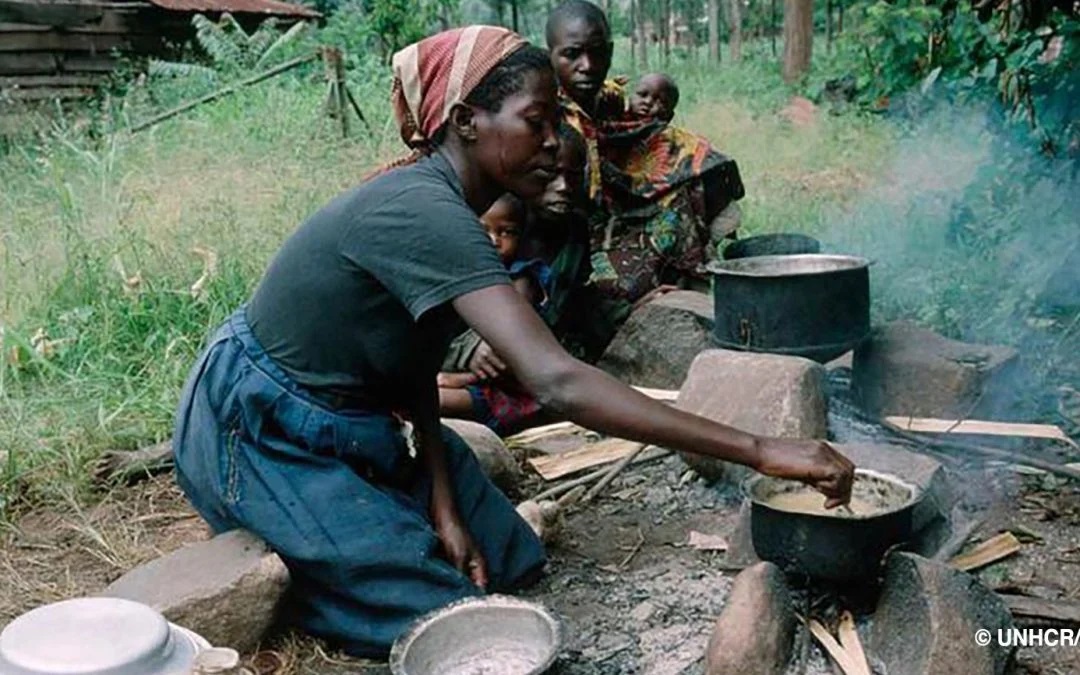
In a post on her Facebook account, the new regional champion addressed the “growing crisis of limited access to clean cooking across the continent”. She stated that “globally, more than 3.7 million people die each year due to exposure to smoke and toxic gases, the majority of them women and children. (…) In Sierra Leone, only 1.5% of the population has access to clean cooking. This means that more than 98% of our population still relies on biomass, including firewood.”
In this fact-check, FactSpace West Africa will verify Dr. Maada Bio’s claim that only 1.5% of the population have access to clean cooking.
Fact-check
Cleaning cooking according to the African Development Bank-affiliated Africa Energy Portal, is: “the transitioning from fossil fuel-aided cooking mechanisms to renewable energy. This is the transition from wood and LPG gases to products like biogas.”
Other international sources have provided similar definitions, like the Netherlands Enterprise Agency, and the World Health Organization (WHO).
WHO “defines fuels and technologies that are clean for health at the point of use as solar, electricity, biogas, liquefied petroleum gas (LPG), natural gas, alcohol fuels, as well as biomass stoves that meet the emission targets in the WHO Guidelines”.
So what is the percentage of Sierra Leoneans who have access to clean cooking?
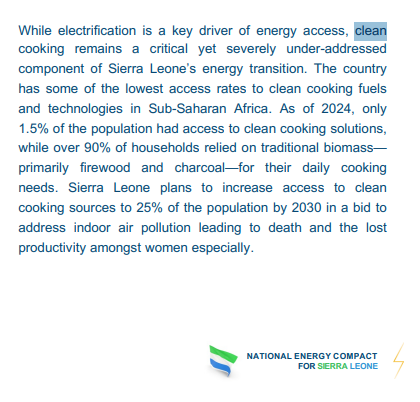
According to the Government of Sierra Leone’s National Energy Compact report, developed in collaboration with the World Bank and the AfDB and published in September 2025, “Clean cooking access is critically limited, at just 1.5%. … While over 90% of households relied on traditional biomass— primarily firewood and charcoal—for their daily cooking needs.”
But, other sources like WHO say in 2023 it could have been as low as 0.9% of the population with primary reliance on clean fuels and technologies for cooking. Also the global network Local Governments for Sustainability (ICLEI), in a report published at the end of 2024, stated that in Sierra Leone “access to clean cooking fuels and technologies is at a much lower level of about 1%, with the majority (99%) relying on traditional biomass fuels”.
| Source | Year | Clean energy use percentage |
| WHO | 2023 | Could be as low as 0.9% |
| ICLEI | 2024 | About 1% |
| WB, Sierra Leone report | 2025 | 1.5% |
| First Lady Maada Bio | 2026 | 1.5% |
From the above, publicly available data shows the 1.5% access to clean cooking energy among the Sierra Leonean population is correct.
Verdict:
The claim is rated True.
Why is clean cooking in Sierra Leone so low?
The Energy Sector Management Assistance Program, a World Bank-backed institution, outlines that clean cooking adoption in Sierra Leone remains limited due to a combination of financial, infrastructural, technological, and institutional barriers.
These include limited awareness of clean cooking benefits, cultural preference for traditional methods, high upfront costs, and limited consumer financing. The sector also faces weak distribution networks, inconsistent clean fuel supply, inadequate enterprise financing, limited technical capacity among local producers, poor-quality and non-standardized improved cookstoves, and the absence of testing and certification centers.
Progress is further constrained by unclear institutional responsibilities, fragmented inter-ministerial coordination, and the lack of a robust monitoring and evaluation framework.
Sierra Leone’s government strategy
The Sierra Leone government has embedded clean cooking in its Medium-Term National Development Plan (MTNDP) 2024– 2030. Aiming to “accelerate access to clean cooking solutions from 1.5% to 25% of the population by scaling LPG and bioethanol usage, encouraging local production of clean cooking inputs such as (Liquefied Petroleum Gas) LPG canisters and delivering 1 million improved cooking stoves (ICS)”.
The Clean Cooking Alliance outlines the country’s efforts to address clean energy access through the development of its National Clean Cooking Strategy (2025–2035), launched with support from the Sierra Leone Clean Cooking Delivery Unit, led by Aminata Wurie. The strategy sets five priorities: “improving affordability through subsidies and consumer financing, increasing awareness via public campaigns, strengthening enterprise support through financing and capacity building, enforcing regulation and standards to ensure safety and quality, and enhancing coordination across government agencies and partners such as the Clean Cooking Association of Sierra Leone and the Delivery Units Network”.