

Researched by Lara Zofio and Alfa Shaban
In 2016, when the opposition coalition candidate was declared winner of the elections that longserving Yahya Jammeh was widely expected to win, very little was known about the candidate Adama Barrow, a relatively new entrant into Gambian politics.
The international media, however, chose two metrics to define Barrow, the man who had finally made history by unseating an incumbent who had been in office for over two decades at the time.
The UK Guardian highlighted Barrow’s previous job as a security guard at Argos catalogue store in North London, while Nigeria’s The Cable portal highlighted the job and his support for Arsenal in their headline.

Barrow’s history with Arsenal was, therefore, established almost immediately after he became president-elect. So, it was no surprise that he shared a congratulatory message with the team when the Mikel Arteta-led side clinched their first Premier League trophy in 22 years.
RelatedNews
“I join all other Arsenal Football Club fans across the world in congratulating the “Gunners” for winning the 2025-2026 Premier League Championship. The impressive performance of Arsenal during the football season is a classic manifestation of quick response, skills, resolute team spirit, and focus.
“Arsenal has once more demonstrated the power of sports to promote international understanding and our shared passion for regeneration,” his post read.
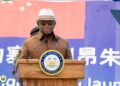
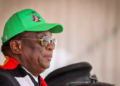
The image attached to the May 21 post was of President Barrow wearing an Arsenal branded long-sleeved jersey. FactSpace traced the image to a post by the State House of The Gambia (the Presidency) when Barrow attended the 2026 May Day celebrations in Banjul.
The 2025/2026 EPL trophy party at State House
On June 24, 2026; an Arsenal EPL victory party was held at State House drawing mixed reactions across social media platforms. In this piece, we look at the issues opponents of the party raised and the defense that government officials advanced.
On X, posts about the event were limited, including one by a football correspondent and broadcaster, Chris Wheatley, whose post attracted significant reactions including 17 comments, 372 reposts and 1.7K likes. Wheatley’s post had been viewed over 61,000 times.

Critique and fight back
The dominant reaction was on Facebook. Despite close to 50% of Gambians having internet access, just about 400,000 use Facebook (the most popular social media platform ) in a country of over 2.8 million people.
Many critical social media posts (here, here, here, here, here) reacting to the Arsenal party criticised the timing of the event, linking it to ongoing electricity and water shortages affecting parts of the country (here, here and here). The opposition party, United Movement for Change (UMC), has also echoed these concerns.
Information Minister, Ismaila Ceesay, in a Facebook post mounted a defense stating: “President Adama Barrow’s support for football is no secret. Like millions of Gambians, he enjoys the beautiful game and understands its power to bring people together across political, ethnic and social divides.
“Celebrating a sporting achievement does not mean the President has abandoned his responsibilities or is unaware of the challenges facing the country. Leadership is not measured by whether a President spends an hour congratulating football fans. Leadership is measured by results.”
During a National People’s Party (NPP) event in Brikama in the West Coast Region, another minister, Hamat Bah responded to the opposition critique of the Arsenal party, stressing that it was a sign that the president was interested in sports promotion.
“They were saying that the President was celebrating Arsenal, and they made it a big deal, for a president to celebrate a football game, that shows he is interested in sports and that is why he is promoting sports, developing infrastructure…” Ministrer Bah said.
But what is the current utility supply situation in The Gambia?
Local media outlets have reported recurring electricity outages and associated water supply interruptions across several parts of the country (see reports here, here). Residents in multiple areas describe prolonged blackouts, in some cases lasting up to 48 hours, with knock-on effects on water availability due to the reliance of pumping and distribution systems on electricity.
In a recent press release, the Ministry of Petroleum, Energy and Mines stated that the “current interruptions are largely concentrated in parts of the Greater Banjul Area and sections of the West Coast Region, especially during peak demand periods from 6 p.m. onwards,” adding that “provincial regions are largely unaffected and are not experiencing comparable disruptions.”
The Ministry described the situation as a “temporary technical challenge,” noting that power cuts can also disrupt water supply due to reliance on electricity for pumping systems. Officials say the issues are not mainly linked to unpaid debts but to technical faults in the regional grid, compounded by fuel constraints and broader external pressures affecting energy supply chains.
They added that NAWEC continues to operate existing generators while carrying out maintenance and expanding domestic capacity, with plans to reach around 50MW of additional generation in the near term.
Authorities also point to increased regional interconnection through OMVG and the West African Power Pool (WAPP), which enables cross-border electricity trade but can also transmit disruptions across systems. Contracting is also reportedly advanced for a 50MW solar project in Soma, alongside other renewable energy projects.
Political responses
President Adama Barrow has said (see here and here) the country will achieve a stable and uninterrupted electricity supply within the next two to three years, attributing recent disruptions to technical issues that he said have now been resolved.
Speaking at a National People’s Party (NPP) rally in Brikama, he described the outages as temporary and expressed confidence in ongoing efforts to strengthen the energy sector, crediting sustained investment in generation and distribution and arguing that no government since independence has invested more in electricity infrastructure.
He also said the current blackouts affecting daily life would be resolved within about two years. The remarks come ahead of the presidential election scheduled for 5 December 2026, in which electricity reliability has remained a recurring public concern.
Timeline and political context
In a public interview, President Adama Barrow indicated that the electricity disruptions had been ongoing for approximately two weeks as of early June. However, NAWEC already referred in April to an electricity crisis or significant strain on the system.
The broader context is not new. When President Barrow came to office in 2017, addressing persistent electricity shortages was one of the key governance priorities. Despite subsequent investments and infrastructure programmes, critics argue that structural reliability issues persist.
Conclusion
The conversations around the propriety of using state facilities to host an essentially private event continues online and offline while the power supply challenges is also a lived reality for homes and businesses.
With the December 2026 elections fast approaching, it is evident that the power situation will be topical as Barrow’s National People’s Party (NPP) looks to secure a new term for the man who is seeking his third consecutive term as president.