

After over 40 days of hostilities, a Pakistan-brokered two-week ceasefire became the clearest sign of the Middle East conflict slowing down since it started on February 28, 2026, with strikes against Iran by the United States and Israel.
Analysts pointed to the immediate impacts of the war on the wider Gulf Region, including disruption in oil production and supply lines from the centre of the global oil trade.
Days after the war started, President John Dramani Mahama, speaking in Tanzania, expressed alarm over the escalating attacks by the US and Israel on one hand and counter-attacks on Israel and Gulf states by Iran.
He warned that Africa needed to brace for economic shocks because the Middle East was the “epicentre of global oil supplies,” and any sustained instability would inevitably trigger rising crude oil prices with direct negative consequences for African economies.
RelatedNews



According to him, increases in global crude prices quickly translate into higher transport costs, inflationary pressures, and fiscal strain across the continent.
Despite the April 8 ceasefire, in the 38 days of hostilities that followed the February 28 attacks, the global economy got badly hit.
While miles away from the direct impact of the hostilities, the West African region was affected directly through rising fuel and transportation costs, as different countries announced measures related to fuel prices.
IMF warns energy-importing economies
According to the International Monetary Fund (IMF), “Economies heavily dependent on oil imports in Africa and Asia are finding it increasingly hard to access the supplies they need, even at inflated prices.”
“The multi-regional impact is apparent. Energy‑importing economies in Africa, the Middle East and Latin America are feeling the strain from higher import bills on top of already limited fiscal space and external buffers,” the IMF added.
Forecasts about the impact of the war on different African regions were varied, except that West and East Africa were projected to face a primary economic risk related to fuel shortages, as a result of a possible spike in oil prices and the cost of importing fuel.
In this piece, FactSpace West Africa looks at how fuel prices were especially affected across Anglophone West Africa – from Nigeria to Ghana, Liberia to Sierra Leone and The Gambia. In the table below, we track the pre-war prices of fuel and the last prices before the ceasefire was announced.
| Pre-war prices | War-era price | Govt action | |||
| Country | Petrol | Diesel | Petrol | Diesel | Subsidy |
| Ghana | GH¢10.24 | GH¢11.34 | GH¢13.30 | GH¢17.10 | NO |
| Liberia | LD 755 | LD 810 | LD 910 | LD 1080 | NO |
| Nigeria | ₦1,162.5 | ₦1,620 | ₦1,051.47 | ₦1,430 | NO |
| Sierra Leone | NLe28.5 | NLe28.5 | NLe35 | NLe40 | YES |
| The Gambia | D82.50 | D84.60 | D98.00 | 95.00 | YES |
The table below also gives insight into institutions that announce fuel prices. While Ghana and Sierra Leone have Petroleum Regulatory bodies, Liberia and The Gambia have the respective ministries announcing prices. The case of Nigeria is unique because there is the main regulator, the Nigerian Midstream and Downstream Petroleum Regulatory Authority (NMDPRA) is the primary regulator under the Petroleum Industry Act (PIA).
The NMDPRA tracks domestic supply data and oversees the pricing structures of the Dangote Refinery and NNPC – the two main players who announce prices of fuel. In this report, we used announcements by Dangote Refinery because of their dominant role in local fuel supply chain.
| Country | Price announcing institution (s) |
| Ghana | National Petroleum Authority (NPA) |
| Liberia | Ministry of Commerce and Industry, Liberia Petroleum Refining Company (LPRC) |
| Nigeria | Dangote Refinery (we referenced their prices due to its dominant position in local fuel supply chain) |
| Sierra Leone | National Petroleum Regulatory Authority-Sierra Leone |
| The Gambia | Ministry of Petroleum, Energy and Mines |
The subsidy twins – Sierra Leone and The Gambia
As demonstrated in the table above, only two countries announced subsidies during the conflict, with Ghana announcing a price reduction measure after the ceasefire.
The Gambian subsidy was announced via a statement dated April 3, 2026, by the Ministry of Petroleum, Energy and Mines.
Relevant portions read: “The Government of The Gambia has enacted critical measures aimed at safeguarding citizens and businesses from the significant increases in global fuel prices. Recent weeks have seen a sharp rise in international fuel costs, primarily due to the ongoing tensions in the Middle East, which have disrupted oil supplies and transportation routes.”
The government subsequently announced subsidies of D3.29/L and D29.72/L on petrol and diesel, respectively.
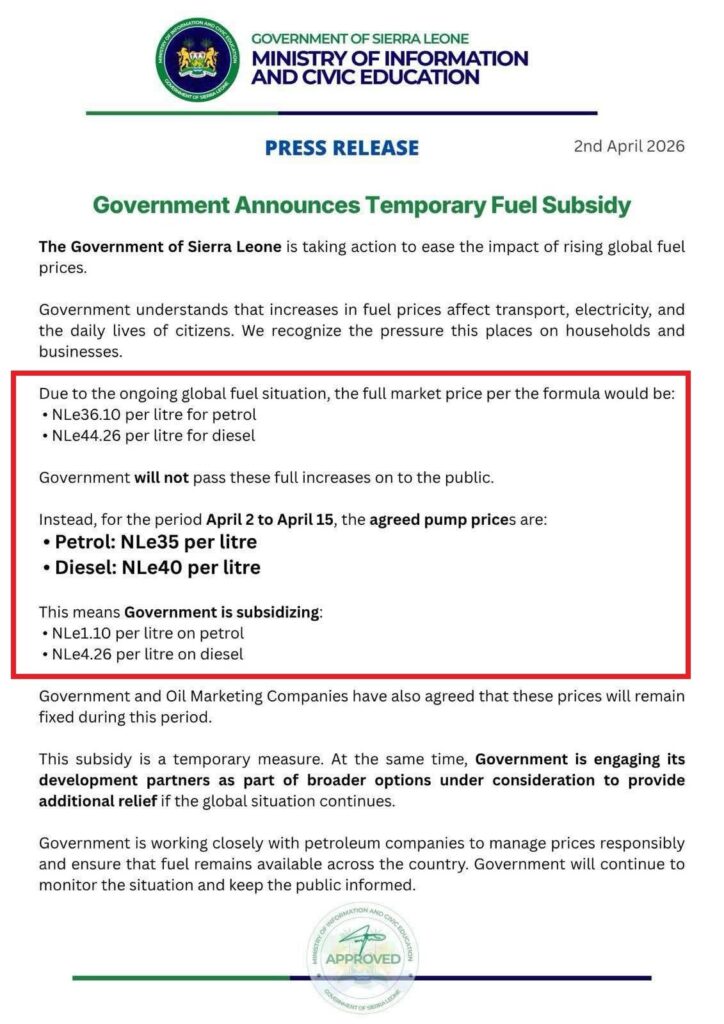
In the case of Sierra Leone, a statement dated April 2, 2026, from the Ministry of Information and Civic Education stated that instead of hikes for April, the government was temporarily subsidising fuel.
Relevant portions of the statement read: “For the period April 2 to April 15, the agreed pump prices are: Petrol NLe35/L and Diesel NLe40/L. This means the government is subsidising NLe1.10/L on petrol and NLe4.26/L on diesel.
“Government and Oil Marketing Companies have agreed that these prices will remain fixed during this period. The subsidy is a temporary measure,” the statement added.
Ghana cabinet’s post-ceasefire fuel tax, margin suspension order
In Ghana, a cabinet meeting held on April 9, 2026, agreed to grant some relief to the population.
“Ministers of Finance and Energy directed by the Cabinet to ensure a reduction in fuel price in the next pricing window through the SUSPENSION of some taxes and margins (said taxes and margins to be announced at the next pricing window).
“This is to last for four weeks and subject to review based on evolving situation in Middle East conflict and movements in crude oil prices,” a post-cabinet statement shared by Minister of government communications, Felix Kwakye Ofosu, stated.
What runs across the countries is that all governments and oil marketers caution that they continue to monitor events on the world market due to the fluid nature of events.
For now, many economic metrics across these countries rely strongly on fuel supply disruptions and whether shipping lines from the Persian Gulf through to other supply routes remain reliably open.