FactSpace West Africa
Donate
  • Home
  • Fact-Checks
    • Latest
    • Trending
  • Country
    • Ghana
    • Gambia
    • Nigeria
    • Liberia
    • Sierra Leone
  • DisinfoLab
  • Media Literacy
    • Learning Materials
    • Digital Tools
  • Who We Are
    • About Us
    • How We Work
    • Principles
    • Submit A Claim
    • Our Team
    • Partners
    • Funding
    • Corrections
    • Press Releases
  • Contact Us
No Result
View All Result
FactSpace West Africa
  • Home
  • Fact-Checks
    • Latest
    • Trending
  • Country
    • Ghana
    • Gambia
    • Nigeria
    • Liberia
    • Sierra Leone
  • DisinfoLab
  • Media Literacy
    • Learning Materials
    • Digital Tools
  • Who We Are
    • About Us
    • How We Work
    • Principles
    • Submit A Claim
    • Our Team
    • Partners
    • Funding
    • Corrections
    • Press Releases
  • Contact Us
No Result
View All Result
FactSpace West Africa
No Result
View All Result
Home Featured

Pumps, prices and subsidies: How Anglophone West Africa managed fuel amid Middle East war

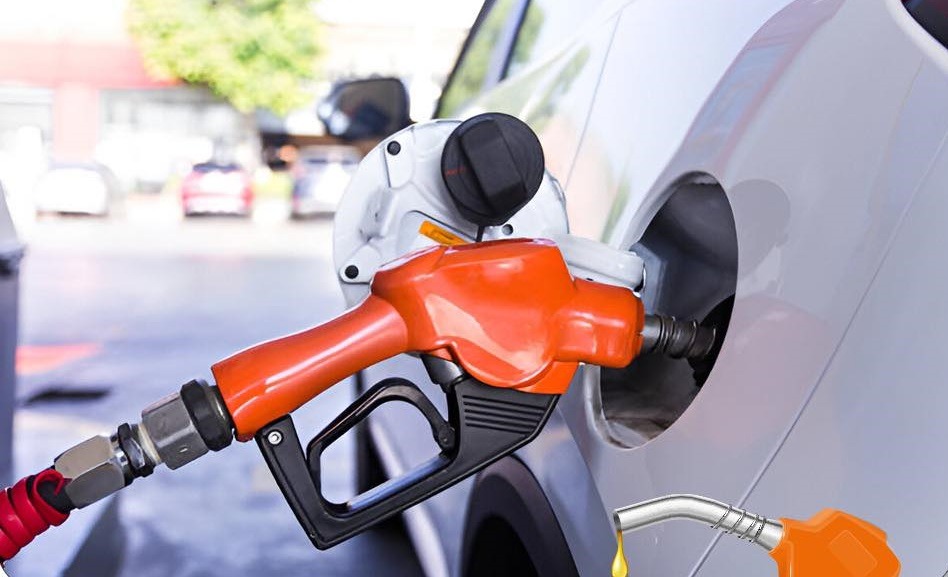
Despite being 1000s of kilometres from the Gulf, West African economies were hit by oil supply disruptions arising from the recent Middle East war. This article looks at how petrol and diesel prices in Sierra Leone, Nigeria, Liberia, Ghana and The Gambia changed and steps some governments took to cushion their populations.

Rahman ShabanbyRahman Shaban
April 10, 2026
in Featured, Gambia, Ghana, Liberia, Nigeria, Sierra Leone
Reading Time: 6 mins read
A A
Pumps, prices and subsidies: How Anglophone West Africa managed fuel amid Middle East war
Share on FacebookShare on Twitter

After over 40 days of hostilities, a Pakistan-brokered two-week ceasefire became the clearest sign of the Middle East conflict slowing down since it started on February 28, 2026, with strikes against Iran by the United States and Israel.

Analysts pointed to the immediate impacts of the war on the wider Gulf Region, including disruption in oil production and supply lines from the centre of the global oil trade.

Days after the war started, President John Dramani Mahama, speaking in Tanzania, expressed alarm over the escalating attacks by the US and Israel on one hand and counter-attacks on Israel and Gulf states by Iran. 

He warned that Africa needed to brace for economic shocks because the Middle East was the “epicentre of global oil supplies,” and any sustained instability would inevitably trigger rising crude oil prices with direct negative consequences for African economies.

RelatedNews

False! Cameroon president Paul Biya did not appoint son as Vice President

False! Cameroon president Paul Biya did not appoint son as Vice President

FactSpace West Africa participates in AIRA Digital Content Production Workshop

FactSpace West Africa participates in AIRA Digital Content Production Workshop

FactSpace West Africa participates in three-day Youth Climate Reporters (YCR) programme

FactSpace West Africa participates in three-day Youth Climate Reporters (YCR) programme

CAF’s AFCON 2025 ruling triggers ‘fake news’ – Verifying Senegal’s trophy with soldiers video, Hakimi’s rejection and Guinea petition

CAF’s AFCON 2025 ruling triggers ‘fake news’ – Verifying Senegal’s trophy with soldiers video, Hakimi’s rejection and Guinea petition

According to him, increases in global crude prices quickly translate into higher transport costs, inflationary pressures, and fiscal strain across the continent.

Despite the April 8 ceasefire, in the 38 days of hostilities that followed the February 28 attacks, the global economy got badly hit.

While miles away from the direct impact of the hostilities, the West African region was affected directly through rising fuel and transportation costs, as different countries announced measures related to fuel prices.

IMF warns energy-importing economies 

According to the International Monetary Fund (IMF), “Economies heavily dependent on oil imports in Africa and Asia are finding it increasingly hard to access the supplies they need, even at inflated prices.”

“The multi-regional impact is apparent. Energy‑importing economies in Africa, the Middle East and Latin America are feeling the strain from higher import bills on top of already limited fiscal space and external buffers,” the IMF added.

Forecasts about the impact of the war on different African regions were varied, except that West and East Africa were projected to face a primary economic risk related to fuel shortages, as a result of a possible spike in oil prices and the cost of importing fuel.

In this piece, FactSpace West Africa looks at how fuel prices were especially affected across Anglophone West Africa – from Nigeria to Ghana, Liberia to Sierra Leone and The Gambia. In the table below, we track the pre-war prices of fuel and the last prices before the ceasefire was announced.

Pre-war pricesWar-era priceGovt action
Country Petrol Diesel Petrol Diesel Subsidy
Ghana GH¢10.24GH¢11.34GH¢13.30 GH¢17.10NO
Liberia LD 755LD 810LD 910 LD 1080NO 
Nigeria ₦1,162.5₦1,620₦1,051.47₦1,430NO
Sierra Leone NLe28.5NLe28.5 NLe35NLe40YES
The Gambia D82.50D84.60D98.0095.00YES

The table below also gives insight into institutions that announce fuel prices. While Ghana and Sierra Leone have Petroleum Regulatory bodies, Liberia and The Gambia have the respective ministries announcing prices. The case of Nigeria is unique because there is the main regulator, the Nigerian Midstream and Downstream Petroleum Regulatory Authority (NMDPRA) is the primary regulator under the Petroleum Industry Act (PIA).

The NMDPRA tracks domestic supply data and oversees the pricing structures of the Dangote Refinery and NNPC – the two main players who announce prices of fuel. In this report, we used announcements by Dangote Refinery because of their dominant role in local fuel supply chain.

Country Price announcing institution (s)
Ghana National Petroleum Authority (NPA)
Liberia Ministry of Commerce and Industry, Liberia Petroleum Refining Company (LPRC)
Nigeria Dangote Refinery (we referenced their prices due to its dominant position in local fuel supply chain) 
Sierra Leone National Petroleum Regulatory Authority-Sierra Leone 
The GambiaMinistry of Petroleum, Energy and Mines

The subsidy twins – Sierra Leone and The Gambia

As demonstrated in the table above, only two countries announced subsidies during the conflict, with Ghana announcing a price reduction measure after the ceasefire.

The Gambian subsidy was announced via a statement dated April 3, 2026, by the Ministry of Petroleum, Energy and Mines.

Relevant portions read: “The Government of The Gambia has enacted critical measures aimed at safeguarding citizens and businesses from the significant increases in global fuel prices. Recent weeks have seen a sharp rise in international fuel costs, primarily due to the ongoing tensions in the Middle East, which have disrupted oil supplies and transportation routes.”

The government subsequently announced subsidies of D3.29/L and D29.72/L on petrol and diesel, respectively. 

PRESS RELEASE

The Ministry of Petroleum, Energy and Mines announces government measures to cushion the impact of rising global fuel prices.

the Government of The Gambia has introduced subsidies to stabilise pump prices for April 2026:
Petrol: D98.00L
Diesel: D95.00L pic.twitter.com/wuzqntGtqE

— Ministry of Information – The Gambia (@Info_Ministry_) April 3, 2026

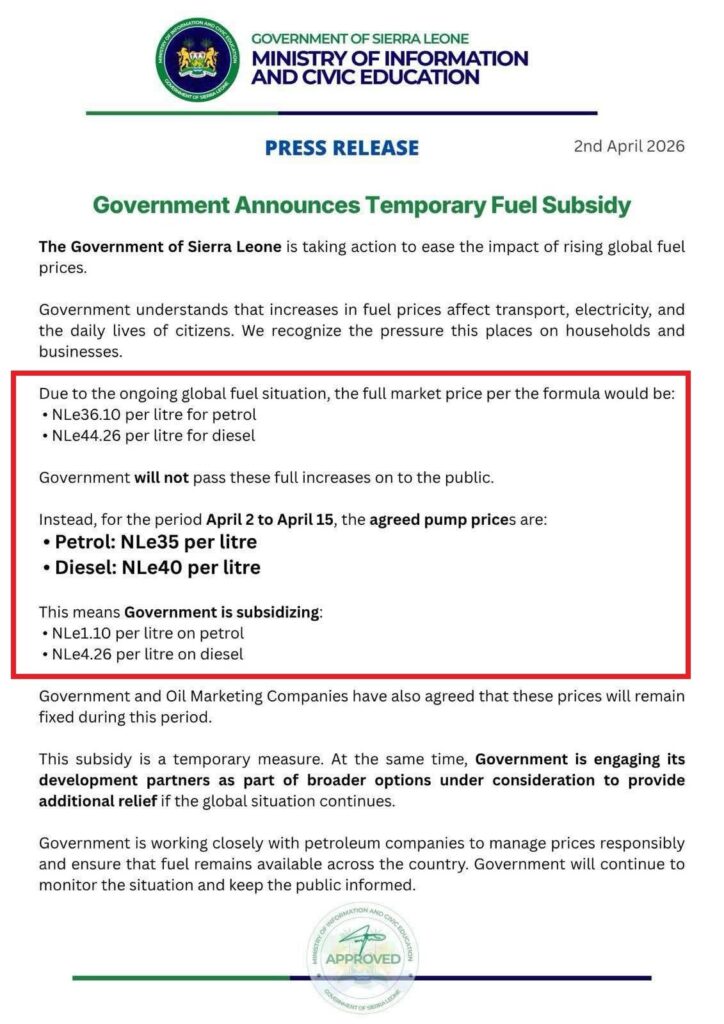
In the case of Sierra Leone, a statement dated April 2, 2026, from the Ministry of Information and Civic Education stated that instead of hikes for April, the government was temporarily subsidising fuel.

Relevant portions of the statement read: “For the period April 2 to April 15, the agreed pump prices are: Petrol NLe35/L and Diesel NLe40/L. This means the government is subsidising NLe1.10/L on petrol and NLe4.26/L on diesel. 

“Government and Oil Marketing Companies have agreed that these prices will remain fixed during this period. The subsidy is a temporary measure,” the statement added.
Pumps, prices and subsidies: How Anglophone West Africa managed fuel amid Middle East war
Fig. 1 – Temporary subsidy announcement by the Sierra Leone government

Ghana cabinet’s post-ceasefire fuel tax, margin suspension order

In Ghana, a cabinet meeting held on April 9, 2026, agreed to grant some relief to the population. 

“Ministers of Finance and Energy directed by the Cabinet to ensure a reduction in fuel price in the next pricing window through the SUSPENSION of some taxes and margins (said taxes and margins to be announced at the next pricing window).

“This is to last for four weeks and subject to review based on evolving situation in Middle East conflict and movements in crude oil prices,” a post-cabinet statement shared by Minister of government communications, Felix Kwakye Ofosu, stated.

What runs across the countries is that all governments and oil marketers caution that they continue to monitor events on the world market due to the fluid nature of events.

For now, many economic metrics across these countries rely strongly on fuel supply disruptions and whether shipping lines from the Persian Gulf through to other supply routes remain reliably open. 
ShareTweetShareSend

Related Posts

False! Cameroon president Paul Biya did not appoint son as Vice President

False! Cameroon president Paul Biya did not appoint son as Vice President

FactSpace West Africa participates in AIRA Digital Content Production Workshop

FactSpace West Africa participates in AIRA Digital Content Production Workshop

FactSpace West Africa participates in three-day Youth Climate Reporters (YCR) programme

FactSpace West Africa participates in three-day Youth Climate Reporters (YCR) programme

CAF’s AFCON 2025 ruling triggers ‘fake news’ – Verifying Senegal’s trophy with soldiers video, Hakimi’s rejection and Guinea petition

CAF’s AFCON 2025 ruling triggers ‘fake news’ – Verifying Senegal’s trophy with soldiers video, Hakimi’s rejection and Guinea petition

FACT-CHECK: Former Nigerian minister didn’t weep over Ayatollah’s killing, viral video is from 2023

FACT-CHECK: Former Nigerian minister didn’t weep over Ayatollah’s killing, viral video is from 2023

FACT-CHECK: Photo of Liberian president, ADC ‘sleeping’ in public is manipulated 

FACT-CHECK: Photo of Liberian president, ADC ‘sleeping’ in public is manipulated 

Recent Posts

False! Cameroon president Paul Biya did not appoint son as Vice President

False! Cameroon president Paul Biya did not appoint son as Vice President

Pumps, prices and subsidies: How Anglophone West Africa managed fuel amid Middle East war

Pumps, prices and subsidies: How Anglophone West Africa managed fuel amid Middle East war

FactSpace West Africa participates in AIRA Digital Content Production Workshop

FactSpace West Africa participates in AIRA Digital Content Production Workshop

FactSpace West Africa participates in three-day Youth Climate Reporters (YCR) programme

FactSpace West Africa participates in three-day Youth Climate Reporters (YCR) programme

CAF’s AFCON 2025 ruling triggers ‘fake news’ – Verifying Senegal’s trophy with soldiers video, Hakimi’s rejection and Guinea petition

CAF’s AFCON 2025 ruling triggers ‘fake news’ – Verifying Senegal’s trophy with soldiers video, Hakimi’s rejection and Guinea petition

Load More

Most Popular

How to use InVID to verify videos – A step-by-step guide

How to use InVID to verify videos – A step-by-step guide

News clip that Ibrahim Traore has closed US Embassy, backed Iran in war with Israel is a deepfake

News clip that Ibrahim Traore has closed US Embassy, backed Iran in war with Israel is a deepfake

FACT-CHECK: COVID-19 vaccine myths and conspiracy theories

FACT-CHECK: COVID-19 vaccine myths and conspiracy theories

False! Cameroon president Paul Biya did not appoint son as Vice President

False! Cameroon president Paul Biya did not appoint son as Vice President

Pumps, prices and subsidies: How Anglophone West Africa managed fuel amid Middle East war

Pumps, prices and subsidies: How Anglophone West Africa managed fuel amid Middle East war

Load More
FactSpace West Africa

FactSpace West Africa

FactSpace West Africa is an independent, non-partisan organisation working to tackle mis/disinformation and propaganda across West Africa.

Follow Us

Quick Links

  • Ghana
  • Gambia
  • Nigeria
  • Liberia
  • Sierra Leone

Memberships

  • Who We Are
  • How We Work
  • Principles
  • Submit A Claim
  • Our Team
  • Partners
  • Funding
  • Corrections
  • Press Releases
  • Contact Us
  • Privacy Policy

© 2025 FactSpace West Africa - All rights reserved - Web development by EnspireFX Websites

No Result
View All Result
  • Home
  • Fact-Checks
    • Latest
    • Trending
  • Country
    • Ghana
    • Gambia
    • Nigeria
    • Liberia
    • Sierra Leone
  • DisinfoLab
  • Media Literacy
    • Learning Materials
    • Digital Tools
  • Who We Are
    • About Us
    • How We Work
    • Principles
    • Submit A Claim
    • Our Team
    • Partners
    • Funding
    • Corrections
    • Press Releases
  • Contact Us

© 2025 FactSpace West Africa - All rights reserved - Web development by EnspireFX Websites