FactSpace West Africa
Donate
  • Home
  • Fact-Checks
    • Latest
    • Trending
  • Country
    • Ghana
    • Gambia
    • Nigeria
    • Liberia
    • Sierra Leone
  • DisinfoLab
  • Media Literacy
    • Learning Materials
    • Digital Tools
  • Who We Are
    • About Us
    • How We Work
    • Principles
    • Submit A Claim
    • Our Team
    • Partners
    • Funding
    • Corrections
    • Press Releases
  • Contact Us
No Result
View All Result
FactSpace West Africa
  • Home
  • Fact-Checks
    • Latest
    • Trending
  • Country
    • Ghana
    • Gambia
    • Nigeria
    • Liberia
    • Sierra Leone
  • DisinfoLab
  • Media Literacy
    • Learning Materials
    • Digital Tools
  • Who We Are
    • About Us
    • How We Work
    • Principles
    • Submit A Claim
    • Our Team
    • Partners
    • Funding
    • Corrections
    • Press Releases
  • Contact Us
No Result
View All Result
FactSpace West Africa
No Result
View All Result
Home Featured

Peter Obi’s claim that ‘over 140 million Nigerians live in multidimensional poverty’ is unproven

Nigerian politician Peter Obi recently stated that over 140 million Nigerians live in multidimensional poverty. The most recent available multidimensional poverty data dates from 2021–2022, with no updated figures for 2025–2026. Estimates from recent World Bank and PwC reports showed high general poverty figures. We rated this claim unproven because there is the need for more research into specific multidimensional poverty data.

FactSpace West AfricabyFactSpace West Africa
June 15, 2026
in Featured, Nigeria
Reading Time: 6 mins read
A A
Peter Obi’s claim that ‘over 140 million Nigerians live in multidimensional poverty’ is unproven
Share on FacebookShare on Twitter

Claim: Today, over 140 million Nigerians live in multidimensional poverty.

Source: Peter Gregory Obi

Verdict: Uproven 

Researched by Lara Zofio

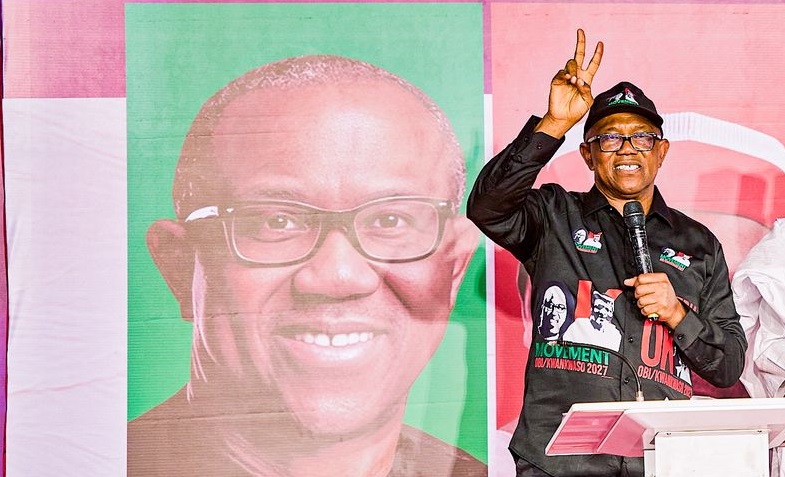
Peter Gregory Obi, former governor of Nigeria’s Anambra State and the Labour Party (LP) presidential candidate in 2023, recently attended the inaugural National Convention of the Nigeria Democratic Congress, after he joined the political party.

RelatedNews
FACT-CHECK: Video of Lagos airport scuffle recirculated as Nigerian retaliation over South Africa xenophobia

FACT-CHECK: Video of Lagos airport scuffle recirculated as Nigerian retaliation over South Africa xenophobia

FACT-CHECK: US govt account on X falsely claims Nigeria evacuated citizens from South Africa, when only Ghana has

FACT-CHECK: US govt account on X falsely claims Nigeria evacuated citizens from South Africa, when only Ghana has

Clean cooking strides in West Africa: Liberia, Sierra Leone, The Gambia lagging as Ghana, Nigeria lead

Clean cooking strides in West Africa: Liberia, Sierra Leone, The Gambia lagging as Ghana, Nigeria lead

FACT-SHEET: Nigeria hasn’t recorded hantavirus case

FACT-SHEET: Nigeria hasn’t recorded hantavirus case

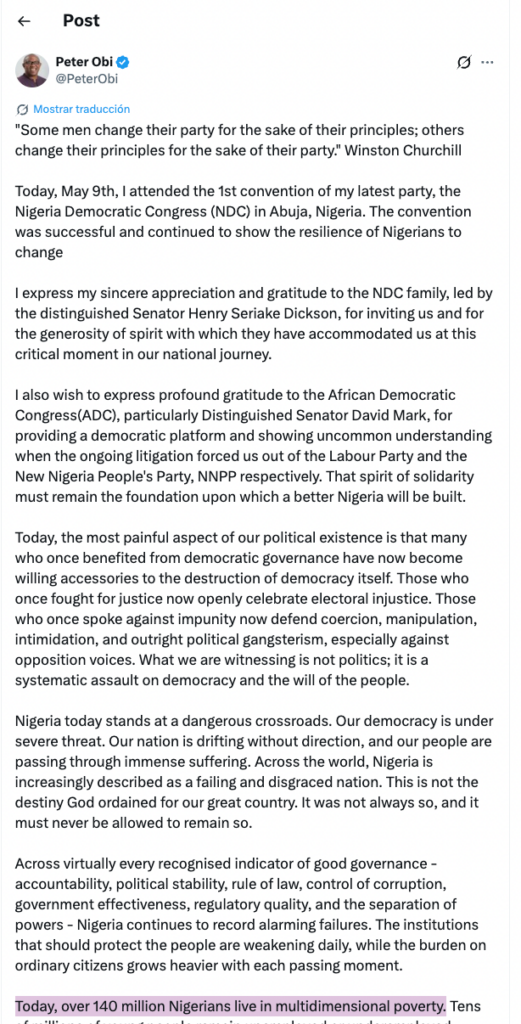
On May 9, 2026 on his X (former Twitter) account, he shared a post with remarks about the NDC convention, while highlighting current challenges afflicting Nigeria and its democracy under the Bola Ahmed Tinubu government.

Obi claimed in his post that: “today, over 140 million Nigerians live in multidimensional poverty”. This report will verify the accuracy of the claim.
Peter Obi’s claim that ‘over 140 million Nigerians live in multidimensional poverty’ is unproven
Fig. 1 – Post by Nigerian politician Peter Obi on X

Fact-check

What is multidimensional poverty?

Multidimensional poverty is a concept developed by the Oxford Poverty & Human Development Initiative (OPHI), which explains that poverty should not be understood only as a lack of income, but as a broader set of overlapping deprivations. 

The Ghana Statistical Service (GSS) defines multidimensional poverty as the many overlapping deprivations that poor people experience beyond just low income. These include deprivations such as poor health, lack of education, and limited access to basic services (water, sanitation, electricity), among others.  

Figures on poverty in Nigeria

To verify Peter Obi’s claim that “over 140 million Nigerians live in multidimensional poverty,” we reviewed the most recently available data from the UNDP’s Multidimensional Poverty Index (MPI 2025). However, the Nigeria-specific figures in this dataset are based on 2021 data. We also examined World Bank estimates, but these were similarly based on 2022 data.

In addition, the Nigeria Bureau of Statistics has published what it describes as its “most extensive national measure of multidimensional poverty to date,” which estimates that 63% of the population — about 133 million people — were multidimensionally poor in 2022.

However, neither these institutions nor other major data sources currently provide more recent, updated figures on multidimensional poverty in Nigeria.

World Bank’s April 2026 Nigeria Development Update

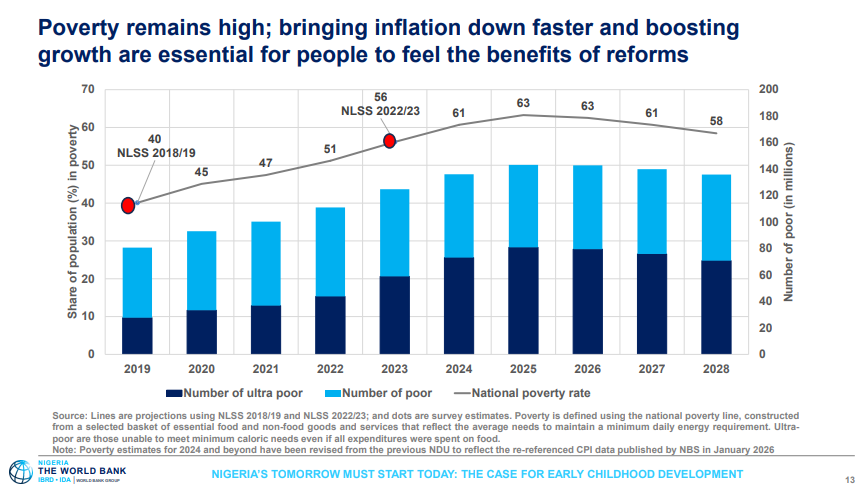
The World Bank recently published its latest Nigeria economic report, the Nigeria Development Update, which includes updated poverty estimates for the country, not multidimensional poverty. 

The report defines poverty using the national poverty line, constructed from “a selected basket of essential food and non-food goods and services that reflect the average needs to maintain a minimum daily energy requirement.”

According to this measure, 63% of Nigeria’s population is projected to be poor in 2026. Based on a current population estimate of 242,109,975, this would amount to over 153 million poor Nigerians.
Peter Obi’s claim that ‘over 140 million Nigerians live in multidimensional poverty’ is unproven
Fig. 2 – Screenshot from the report with data on the national poverty rate

Moreover, PwC’s 2026 Nigeria Economic Outlook projects that poverty “will rise to 62%, or about 141 million people, by 2026.” However, again this figure does not refer to multidimensional poverty. Instead, the estimate is based on straight-line projections using data from the Nigerian Living Standards Survey (NLSS) 2018/19 and 2022/23.

Below is a table summarising all available poverty figures for Nigeria since 2021:

YearPopulation in povertyType of povertySource
202172million (33%)Multidimensional povertyOxford Poverty & Human Development Initiative (OPHI)
2022105million (47%)Multidimensional povertyWorld Bank
2022133 million (63%)Multidimensional povertyNational Bureau of Statistics
2023128million (56%)Only povertyWorld Bank 
2023128million (56%)Only povertyPwC 
2024142million (61%)Only povertyWorld Bank 
2024137million (59%)Only povertyPwC
2025150million (63%)Only povertyWorld Bank 
2025145million (61%)Only povertyPwC
2026153million(63%)Only povertyWorld Bank 
2026141million (62%)Only povertyPwC

Oxfam Novib Nigeria manager speaks 

Although there is no recent multidimensional poverty data for Nigeria in 2025 or 2026, poverty estimates from the World Bank and PwC may serve as a useful proxy to confirm whether “140 million Nigerians live in multidimensional poverty”, as confirmed by Henry Ushie, Programme Manager at Oxfam Novib Nigeria, who noted that “the figure could be true.”

According to Ushie, rising inflation and the increasing cost of living over recent years have pushed many households from the upper-middle and middle-income brackets closer to, or below, the poverty line. As prices of essential goods and services have increased, many people have struggled to maintain their previous living standards across multiple dimensions of well-being.

This trend supports the argument that the millions of Nigerians identified as poor by the World Bank and PwC may also be experiencing forms of multidimensional poverty. While income-based poverty and multidimensional poverty are distinct measures, the deterioration in living conditions described by Ushie suggests a substantial overlap between the two. 

Available poverty estimates suggest that more than 140 million people in Nigeria are poor. However, up-to-date data on multidimensional poverty for 2026 is not currently available. FactSpace West Africa reached out to Nigeria’s National Bureau of Statistics (NBS) to obtain the latest available figures on multidimensional poverty. As of the publication of this article, no response had been received.

Verdict: 

The claim is therefore rated unproven, which according to FactSpace rating means ‘evidence publicly available at this time neither proves nor disproves the statement. More research is needed.’

Tags: Nigeriamultidimensional povertyNational Statistics BureauPeter ObiPovertyPWCWorld Bank
ShareTweetShareSend

Related Posts

Arsenal EPL victory party at State House gets Gambians online talking amid power cuts

Arsenal EPL victory party at State House gets Gambians online talking amid power cuts

FactSpace West Africa facilitates two-part training at UniMAC-IJ: MIL club and New Media class 

FactSpace West Africa facilitates two-part training at UniMAC-IJ: MIL club and New Media class 

FACT-CHECK: Video of Lagos airport scuffle recirculated as Nigerian retaliation over South Africa xenophobia

FACT-CHECK: Video of Lagos airport scuffle recirculated as Nigerian retaliation over South Africa xenophobia

FactSpace participates in DW Akademie workshops on Investigative and Constructive Journalism

FactSpace participates in DW Akademie workshops on Investigative and Constructive Journalism

FACT-CHECK: US govt account on X falsely claims Nigeria evacuated citizens from South Africa, when only Ghana has

FACT-CHECK: US govt account on X falsely claims Nigeria evacuated citizens from South Africa, when only Ghana has

FactSpace participates in IJM-GJA workshop on child trafficking, trauma-informed journalism

FactSpace participates in IJM-GJA workshop on child trafficking, trauma-informed journalism

Recent Posts

Arsenal EPL victory party at State House gets Gambians online talking amid power cuts

Arsenal EPL victory party at State House gets Gambians online talking amid power cuts

FactSpace West Africa facilitates two-part training at UniMAC-IJ: MIL club and New Media class 

FactSpace West Africa facilitates two-part training at UniMAC-IJ: MIL club and New Media class 

FACT-CHECK: Video of Lagos airport scuffle recirculated as Nigerian retaliation over South Africa xenophobia

FACT-CHECK: Video of Lagos airport scuffle recirculated as Nigerian retaliation over South Africa xenophobia

FactSpace participates in DW Akademie workshops on Investigative and Constructive Journalism

FactSpace participates in DW Akademie workshops on Investigative and Constructive Journalism

Peter Obi’s claim that ‘over 140 million Nigerians live in multidimensional poverty’ is unproven

Peter Obi’s claim that ‘over 140 million Nigerians live in multidimensional poverty’ is unproven

Load More

Most Popular

Sierra Leone’s new National Security document: 10 key points on cybersecurity 

Hoax! WhatsApp message of Sierra Leone president gifting 20GB data is a scam

Ghana, corruption and the U.S. News 2020 Best Countries rankings

Ghana, corruption and the U.S. News 2020 Best Countries rankings

FACT-CHECK: Will the world experience 3 days of darkness due to solar eclipse?

FACT-CHECK: Will the world experience 3 days of darkness due to solar eclipse?

FactSpace West Africa admitted into UNESCO MIL Alliance 

FactSpace West Africa admitted into UNESCO MIL Alliance 

News clip that Ibrahim Traore has closed US Embassy, backed Iran in war with Israel is a deepfake

News clip that Ibrahim Traore has closed US Embassy, backed Iran in war with Israel is a deepfake

Load More
FactSpace West Africa

FactSpace West Africa

FactSpace West Africa is an independent, non-partisan organisation working to tackle mis/disinformation and propaganda across West Africa.

Follow Us

Quick Links

  • Ghana
  • Gambia
  • Nigeria
  • Liberia
  • Sierra Leone

Memberships

  • Who We Are
  • How We Work
  • Principles
  • Submit A Claim
  • Our Team
  • Partners
  • Funding
  • Corrections
  • Press Releases
  • Contact Us
  • Privacy Policy

© 2025 FactSpace West Africa - All rights reserved - Web development by EnspireFX Websites

No Result
View All Result
  • Home
  • Fact-Checks
    • Latest
    • Trending
  • Country
    • Ghana
    • Gambia
    • Nigeria
    • Liberia
    • Sierra Leone
  • DisinfoLab
  • Media Literacy
    • Learning Materials
    • Digital Tools
  • Who We Are
    • About Us
    • How We Work
    • Principles
    • Submit A Claim
    • Our Team
    • Partners
    • Funding
    • Corrections
    • Press Releases
  • Contact Us

© 2025 FactSpace West Africa - All rights reserved - Web development by EnspireFX Websites