


Claim: Nigeria confirms its first case of hantavirus
Source: X
Verdict: False
Researched by Gifty Danso
On the back of recent global concerns about the spread of the hantavirus linked to a cruise ship, an X user, Sir Chucho claimed on Thursday, May 7, 2026; that Nigeria had confirmed a case of the viral disease.
RelatedNews




The post made hours after the World Health Organisation Chief held a media briefing, has been widely interacted with, garnering at least a million views with over 1,500 comments, 1,100 reposts, 7,400 likes and 408 bookmarks.

Given the viral nature of his post and conversations around the disease, FactSpace West Africa decided to verify the claim, due to its potential impact on public health and safety.
Fact-check
We first checked with Nigeria’s health ministry and its Center for Disease Control (NCDC). There was no information or health alert that the country had confirmed a case of hantavirus. We also checked credible Nigeria news portals, but there were no reports of the country recording a hantavirus case.
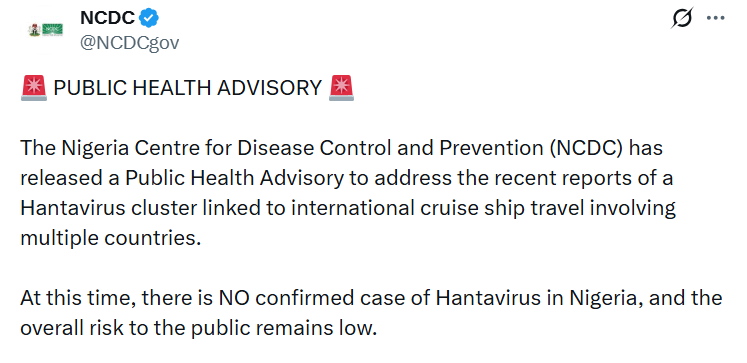
The NCDC on May 9 issued a Public Health Advisory that said: “The Nigeria Centre for Disease Control and Prevention (NCDC) has released a Public Health Advisory to address the recent reports of a Hantavirus cluster linked to international cruise ship travel involving multiple countries.
“At this time, there is NO confirmed case of Hantavirus in Nigeria, and the overall risk to the public remains low.”
We further checked with two Nigeria journalists – Promise Eze, who works with the Cabal and Mariya Shuaibu Suleiman with Premium Times. Both journalists told us that Nigeria hadn’t recorded any hantavirus case.
What we know so far after WHO briefing
The World Health Organization (WHO) held a media briefing on Thursday, confirming that eight cases have been reported so far, including three deaths. Five of the eight cases have been confirmed as hantavirus.
The global health body stated that the virus does not spread the same way as COVID-19, adding that while it’s a serious incident, its assessment of the overall public health risk is low.
WHO Director-General, Dr Tedros Adhanom Ghebreyesus, indicated that it has also alerted 12 countries whose citizens disembarked from the cruise ship at St. Helena, a British territory in the South Atlantic. The countries include; Canada, Denmark, Germany, the Netherlands, New Zealand, Saint Kitts and Nevis, Singapore, Sweden, Switzerland, Türkiye, the UK and the US.
Verdict:
The claim that Nigeria has confirmed a case of hantavirus is therefore false.
What is hantavirus?
According to the WHO, hantaviruses are zoonotic viruses that naturally infect rodents and are occasionally transmitted to humans, which can cause severe diseases in some cases.
Each hantavirus is typically associated with a specific rodent reservoir species, in which the virus causes long‑term infection without apparent illness, the WHO further said.
“Although many hantavirus species have been identified worldwide, only a limited number are known to cause human disease.”
The Andes virus, known to be part of hantaviruses present in North, Central and South America is known to cause limited human-to-human transmission among close and prolonged contacts, primarily in Argentina and Chile. It is the same species identified in the current spread.
Transmission
People usually get infected through contact with infected rodents or their urine, droppings or saliva. Infection may also occur although less commonly, through rodent bites.
Activities that involve contact with rodents such as cleaning enclosed or poorly ventilated spaces, farming, forestry work and sleeping in rodent-infested dwellings can increase exposure.
Symptoms
Infection with hantaviruses can cause a range of illnesses, including severe disease and death.
Symptoms usually begin between one and eight weeks after exposure, depending on the type of virus. Early signs include high fever, headaches, muscle aches, accompanied with gastrointestinal symptoms such as abdominal pain, nausea or vomiting.
“In the Americas, hantaviruses can cause hantavirus cardiopulmonary syndrome (HCPS), a severe respiratory illness, with a case fatality rate up to 50%. In Europe and Asia, hantaviruses cause haemorrhagic fever with renal syndrome (HFRS).
Treatment and cure
There is no cure yet for hantavirus.
According to the WHO, treatment is supportive and focuses on close clinical monitoring and management of respiratory, cardiac and kidney complications.
Prevention
Preventing hantavirus infection largely depends on reducing contact between people and rodents. Such measures include:
- keeping homes and workplaces clean
- sealing openings that allow rodents to enter buildings
- storing food securely
- using safe cleaning practices in areas contaminated by rodents
- avoiding dry sweeping or vacuuming rodent droppings
- dampening of contaminated areas before cleaning
- strengthening hand hygiene practices.