

Introduction
Every year, the World Economic Forum (WEF) releases its Global Risks Report with the view to help policy makers (government) and other players in the sustainable development chain (local and international) to review, evaluate and make projections relative to plans and actions.
The 2026 report is the 21st edition, and it highlights in its key findings that “2026 marks an age of competition. As cooperative mechanisms crumble, with governments retreating from multilateral frameworks, stability is under siege.”
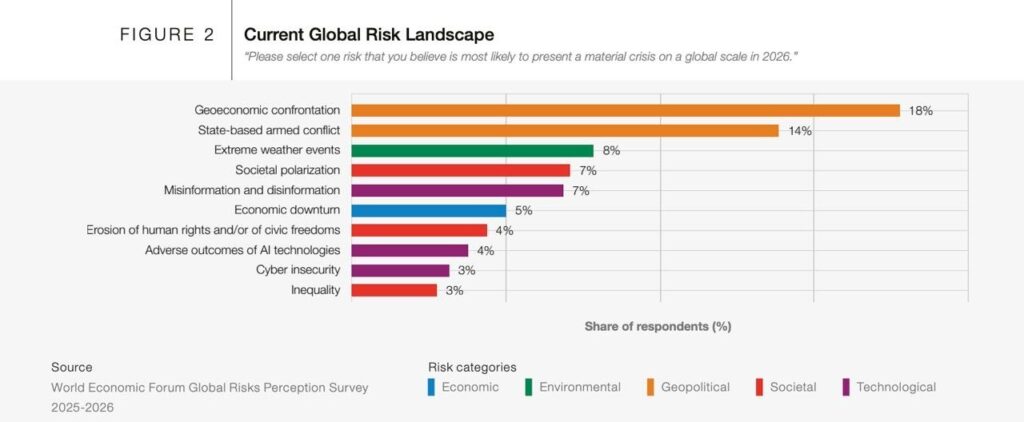
While geoeconomic confrontation tops the list of risks most likely to trigger a material global crisis in 2026 (18% of respondents), state-based armed conflict, (14% of respondents) and extreme weather events (8%) complete the top three global risks.
“Global risk” is defined as the possibility of the occurrence of an event or condition that, if it occurs, would negatively impact a significant proportion of global GDP, population or natural resources.
RelatedNews



In this piece, FactSpace West Africa analyzes the top risks as projected to affect all listed West African countries, from the most populous Nigeria, through to Ghana, Cote d’Ivoire, Liberia to Mali in the Sahel, then through The Gambia and to Senegal ending on the island nation of Cape Verde.
Top-most risk by listed countries
Lack of economic opportunity or unemployment is perceived as the top-most risk in six of the listed countries: Cote d’Ivoire, the Gambia, Ghana, Liberia, Nigeria and Senegal.
According to the report, ‘lack of economic opportunity or unemployment’ is defined as non-existent, inadequate or inequitable public infrastructure, services and social protections. Throughout West Africa, the creation of formal jobs has not kept pace with the growth of the population.
The two other West African countries with different top-most risks were Cape Verde, which has inflation as its top-most risk and lack of economic opportunity or unemployment as its second highest risk. Mali on the other hand had cyber insecurity as its top-most risk and did not have lack of economic opportunity or unemployment in its top 5 risks.
| Cote d’Ivoire | The Gambia |
| Despite its strong GDP growth and investment, Cote d’Ivoire finds it difficult to convert economic expansion into jobs for its youth. | Gambia is heavily reliant on tourism and agriculture but it has been unable to provide sufficient jobs for its working population. |
| Ghana | Liberia |
| According to the Global Risks Report 2026, Ghana’s number one risk is lack of economic opportunity or unemployment. There is widespread underemployment and unstable employment. | In Liberia, weak private sector growth and limitation in diversity of the economy impede the creation of quality jobs. Lack of employment opportunities is a major development risk worsened by inconsistent investment and structural barriers. |
| Nigeria | Senegal |
| Nigeria has the largest economy in West Africa yet it continues to struggle with high levels of unemployment. Challenges like skills mismatch, limited access to capital and a dominant informal sector worsen the lack of stable employment. | There are significant labour market challenges in Senegal especially for young people. Youth unemployment rates are notably high, indicating a barrier to the youths’ long-term economic participation. |
| Information in this table was derived using generative AI platform, Chat GPT | |
Three technological risks – Ivory Coast, Ghana, Senegal, Mali affected
Technological risks listed in the report included Misinformation and disinformation, Adverse outcomes of artificial intelligence technologies and cyber insecurity.
Saadia Zahidi, WEF Managing Director in her preface to the report said: “technological acceleration, while driving unprecedented opportunities, is also generating significant risks in the form of misinformation and disinformation, a top short-term concern, and creating anxiety about the potentially adverse long- term outcomes of AI, a risk that sees the sharpest increase in rank between the short term and the long term across all 33 risks covered.”
Across West Africa, misinformation and disinformation were listed as risks for Cote d’Ivoire and Senegal while adverse outcomes of AI technologies and cyber insecurity were listed risks affecting Ghana and Mali respectively.
| Risk variable | WEF definition |
| Misinformation and disinformation | Persistent false information (deliberate or otherwise) widely spread through media networks, shifting public opinion in a significant way towards distrust in facts and authority. Includes, but is not limited to: false, imposter, manipulated and fabricated content. |
| Adverse outcomes of AI technologies | Intended or unintended negative consequences of advances in AI and related technological capabilities (including generative AI) on individuals, businesses, ecosystems and/or economies. |
| Cyber insecurity | The state of vulnerability in digital systems, either accidental or deliberate in nature, that can be exploited by cybercriminal or malicious actors. Includes, but is not limited to: cybercrime (including ransomware, data theft and online fraud) and exploitation by cybercriminals or malicious actors to interfere with government operations, conduct espionage and impact national security. |
Two other most popular risk factors
Decline in health and wellbeing and insufficient public services and social protections (including education, infrastructure, pensions) are the other two risk factors that got listed 6 times across the region.
The report defines decline in health and wellbeing as: “Regular or chronic impacts on physical and mental health and well-being that require substantive medical attention and/or limit activities of daily living. Includes, but is not limited to: conditions linked to ageing; excessive consumption habits; and climate change (including heatwaves) and pollution.”
While the issue of insufficient public services and social protections is captured as follows: “Non-existent, inadequate or inequitable public infrastructure, services and social protections. Includes, but is not limited to: unaffordable or inadequate social security and benefits; housing; public education; child and elderly care; healthcare; sanitation and transportation systems; and pension systems.”
It is widely known that a combination of low investment in critical health infrastructure has been a bane for countries in sub-Saharan Africa, which situation has often increased the vulnerability of its populations.
“Public health efforts across Africa are under threat, funding is among the challenges, noting that this makes the continued engagement and energy around NTD (Neglected Tropical Diseases) elimination even more commendable,” said Dr Raji Tajudeen, Africa CDC Acting Deputy Director General and Head, Division of Public Health Institutes and Research.
“The African Region is endemic for 20 of the 21-priority neglected tropical diseases; affecting over 565 million people and comprising 35 per cent of the global disease burden,” said Dr Ibrahima Soce Fall – Global NTD Director at the WHO. “These diseases lead to significant morbidity, including physical and visual impairments, severe malnutrition, chronic pain, disfigurement, stigma and mental health issues, and death,” he said.
| Risk variable | Frequency |
| Decline in health and wellbeing | 6 |
| Insufficient public services and social protections (incl. education, infrastructure, pensions) | 6 |
| Inequality (wealth, income) | 3 |
| Crime and illicit economic activity | 3 |
Inflation, misinformation and disinformation, economic downturn (e.g. recession, stagnation) and debt (public, corporate, household) each appeared twice in the list while talent and/or labour shortages, erosion of human rights and/or civic freedoms, adverse outcomes of artificial intelligence technologies, infectious diseases, pollution (air, water, soil), biodiversity loss and ecosystem collapse and cyber insecurity appeared once each.
Conclusion
The risks highlighted per country while representing pointers that policymakers and other development partners can leverage when it comes to interventions, the regional trend is a metric that should at all times be analyzed and factored into collective efforts to better the lot of West Africans in an increasingly integrated era.
While the technological risks may appear less pronounced, the continued growth of internet access across the subregion and continent at large and growth of social media population means that it is only a matter of time before tech-related risks could begin to grow hence the need for mitigation measures in the short to medium and long term.