FactSpace West Africa
Donate
  • Home
  • Fact-Checks
    • Latest
    • Trending
  • Country
    • Ghana
    • Gambia
    • Nigeria
    • Liberia
    • Sierra Leone
  • DisinfoLab
  • Media Literacy
    • Learning Materials
    • Digital Tools
  • Who We Are
    • About Us
    • How We Work
    • Principles
    • Submit A Claim
    • Our Team
    • Partners
    • Funding
    • Corrections
    • Press Releases
  • Contact Us
No Result
View All Result
FactSpace West Africa
  • Home
  • Fact-Checks
    • Latest
    • Trending
  • Country
    • Ghana
    • Gambia
    • Nigeria
    • Liberia
    • Sierra Leone
  • DisinfoLab
  • Media Literacy
    • Learning Materials
    • Digital Tools
  • Who We Are
    • About Us
    • How We Work
    • Principles
    • Submit A Claim
    • Our Team
    • Partners
    • Funding
    • Corrections
    • Press Releases
  • Contact Us
No Result
View All Result
FactSpace West Africa
No Result
View All Result
Home Featured

Why misinformation spreads faster than truth: FactSpace joins Africanews online debate

FactSpace West AfricabyFactSpace West Africa
February 4, 2026 - Updated on February 11, 2026
in Featured, Press Releases
Reading Time: 4 mins read
A A
Why misinformation spreads faster than truth: FactSpace joins Africanews online debate
Share on FacebookShare on Twitter

February 4, 2026 – Executive Director of FactSpace West Africa, Rabiu Alhassan, participated in an online debate hosted by Africanews on information disorder.

The hour-long debate under the theme: “Why misinformation spreads faster than truth,” was moderated by Africanews journalist Michael Oduor. Other discussants aside from Rabiu were psychologist Michael Asaku-Yeboah; a lecturer in Journalism and Digital Media, Dr Trust Matsilele, and a Senior Special Assistant on Digital Communications to the Nigerian President, O’tega Ogra.

Opening the debate, the moderator emphasized that the discussion was driven by the growing speed and reach of misinformation in the digital age, noting that “Now a lie can travel halfway around the world while the truth is still putting on its shoes.”

Why misinformation spreads faster than truth: FactSpace joins Africanews online debate

Speaking on the effectiveness of information verification as a means to combating misinformation, Rabiu emphasised that fact-checking remains effective when grounded in the understanding of local context. 

RelatedNews
Combatting AI with AI – The case of Google SynthID

Combatting AI with AI – The case of Google SynthID

FactSpace West Africa participates in CDD-Ghana panel discussion on democratic resilience at AFSA 2025

FactSpace West Africa participates in CDD-Ghana panel discussion on democratic resilience at AFSA 2025

FactSpace West Africa signs up as member of Global Digital Rights Coalition for WSIS (GDRC-WSIS)

FactSpace West Africa signs up as member of Global Digital Rights Coalition for WSIS (GDRC-WSIS)

‘The Fact Space’ – FactSpace West Africa starts weekly radio show 

‘The Fact Space’ – FactSpace West Africa starts weekly radio show 

He explained that fact-checking strategies must go beyond simply correcting falsehoods and instead leverage existing community systems and networks to ensure verified information reaches and meaningfully engages the public.

“Fact-checking actually works, but there is the need to be more nuanced in giving the response than just saying fact-checking works…based on the understanding of local nuances and contexts, there are times we strategise to ensure that, whatever checks we produce, or verified information we produce leveraging on already existing systems and networks, we are able to make the most in terms of reaching the public and engaging the public,” he said.

Rabiu also stressed that political actors cannot be excluded from accountability, noting that “a significant portion of our fact-checks focus on claims made by politicians that turn out to be inaccurate or partially false.”

Weighing in on the speed that false information travels as compared to truth, psychologist Michael Asaku-Yeboah explained that the spread of misinformation is largely rooted in human cognition rather than a lack of intelligence.

“The uncomfortable truth is that we have all shared misinformation, whether we like it or not. And it is not because we are not intelligent and it is not because we are not educated. It is a simple thing that our brains are wired in a certain way … That we tend to be more susceptible to protecting ourselves and our environment and our neighbours and our friends and our family than actually taking the time to go step by step to really make sure that the  information we are getting is accurate,” he added.

Aide to the Nigerian president, O’tega Ogra argued that misinformation spreads faster because it is deliberately engineered to trigger emotions. 

According to him, false information is designed to provoke fear and anger making it more likely to travel far, while truth often lacks the same emotional pull. He also stressed the need for governments to take a more proactive approach to communication.

From a media systems perspective, Dr Trust Matsilele described misinformation as easier to monetise and amplify. “It is easier to profit or it’s easier to monetise anything that can go viral like misinformation, disinformation, fake news.

“It easily goes viral because it focuses on what is simple, and in large part that lacks nuance, that requires verification. And in most cases, people struggle to process information that requires nuance, that requires verification,” he explained.

By the end of the debate, the panel broadly agreed that while social media accelerates the spread of false information, misinformation is ultimately driven by human behaviour. As Dr Matsilele noted, “I would not say social media is inherently a problem, it helps us to see the problem. I think that certainly, the problem is human beings. We love fake news, especially if it helps aid our deep interest.”

What is the Africanews debate about? 

Africanews is a pan-African news channel that broadcasts in English and French. It is a subsidiary of Lyon-based Euronews. They run satellite and online TV channels as well as digital platforms.

The Africanews Debates is a platform where topical African issues are discussed with experts within and outside of the continent. The topics range from the economy, politics, environment and diplomacy. 
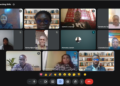
You can watch the full debate here: 

Tags: AfricanewsFactSpace West Africamisinformationsocial media
ShareTweetShareSend

Related Posts

News clip that Ibrahim Traore has closed US Embassy, backed Iran in war with Israel is a deepfake

News clip that Ibrahim Traore has closed US Embassy, backed Iran in war with Israel is a deepfake

FACT-CHECK: Claim that Nigeria’s Sharia Council rejected INEC Chairman because of religion is misleading

FACT-CHECK: Claim that Nigeria’s Sharia Council rejected INEC Chairman because of religion is misleading

FactSpace facilitates information verification sessions for Master’s students at University of Ghana

FactSpace facilitates information verification sessions for Master’s students at University of Ghana

FACT-CHECK: Claim that 300 infants die out of 1,000 live births in The Gambia is False

FACT-CHECK: Claim that 300 infants die out of 1,000 live births in The Gambia is False

SCAM: WhatsApp message about Mufti Menk offering Ramadan cash to Nigerians is False

SCAM: WhatsApp message about Mufti Menk offering Ramadan cash to Nigerians is False

FactSpace participates in first Africa Forum on Countering Foreign Interference in Dakar, Senegal

FactSpace participates in first Africa Forum on Countering Foreign Interference in Dakar, Senegal

Recent Posts

News clip that Ibrahim Traore has closed US Embassy, backed Iran in war with Israel is a deepfake

News clip that Ibrahim Traore has closed US Embassy, backed Iran in war with Israel is a deepfake

FACT-CHECK: Claim that Nigeria’s Sharia Council rejected INEC Chairman because of religion is misleading

FACT-CHECK: Claim that Nigeria’s Sharia Council rejected INEC Chairman because of religion is misleading

FactSpace facilitates information verification sessions for Master’s students at University of Ghana

FactSpace facilitates information verification sessions for Master’s students at University of Ghana

FACT-CHECK: Claim that 300 infants die out of 1,000 live births in The Gambia is False

FACT-CHECK: Claim that 300 infants die out of 1,000 live births in The Gambia is False

SCAM: WhatsApp message about Mufti Menk offering Ramadan cash to Nigerians is False

SCAM: WhatsApp message about Mufti Menk offering Ramadan cash to Nigerians is False

Load More

Most Popular

News clip that Ibrahim Traore has closed US Embassy, backed Iran in war with Israel is a deepfake

News clip that Ibrahim Traore has closed US Embassy, backed Iran in war with Israel is a deepfake

SCAM: WhatsApp message about Mufti Menk offering Ramadan cash to Nigerians is False

SCAM: WhatsApp message about Mufti Menk offering Ramadan cash to Nigerians is False

How to use TinEye to verify images – a step-by-step guide

How to use TinEye to verify images – a step-by-step guide

WEF Global Risks Report 2026: Analysis of West Africa’s top risks

WEF Global Risks Report 2026: Analysis of West Africa’s top risks

FACT-CHECK: Viral clip of veiled women being assaulted shows an incident in Ghana, not southern Nigeria

FACT-CHECK: Viral clip of veiled women being assaulted shows an incident in Ghana, not southern Nigeria

Load More
FactSpace West Africa

FactSpace West Africa

FactSpace West Africa is an independent, non-partisan organisation working to tackle mis/disinformation and propaganda across West Africa.

Follow Us

Quick Links

  • Ghana
  • Gambia
  • Nigeria
  • Liberia
  • Sierra Leone

Memberships

  • Who We Are
  • How We Work
  • Principles
  • Submit A Claim
  • Our Team
  • Partners
  • Funding
  • Corrections
  • Press Releases
  • Contact Us
  • Privacy Policy

© 2025 FactSpace West Africa - All rights reserved - Web development by EnspireFX Websites

No Result
View All Result
  • Home
  • Fact-Checks
    • Latest
    • Trending
  • Country
    • Ghana
    • Gambia
    • Nigeria
    • Liberia
    • Sierra Leone
  • DisinfoLab
  • Media Literacy
    • Learning Materials
    • Digital Tools
  • Who We Are
    • About Us
    • How We Work
    • Principles
    • Submit A Claim
    • Our Team
    • Partners
    • Funding
    • Corrections
    • Press Releases
  • Contact Us

© 2025 FactSpace West Africa - All rights reserved - Web development by EnspireFX Websites